
How to Check Criminal History in Albany
Begin with the record itself. An Albany Police report describes an incident or arrest made by city officers. A Dougherty County Jail entry shows custody and booking. Albany Municipal Court records show ordinance, traffic, DUI, and other matters within that court's authority. State and Superior Court files show county misdemeanor and felony prosecutions. Each source answers a different part of an Albany criminal records question.
- Identify whether Albany Police, another agency, or a court created the record.
- Request the APD incident or arrest report through Albany's JustFOIA portal or Main Desk.
- Check Municipal Court for city cases and use its ticket portal only for tickets it covers.
- Look at the Dougherty jail and the proper county court when an Albany arrest moved beyond city jurisdiction.
- Use Georgia's official state repository products only when the question calls for statewide conviction or fingerprint-supported history.
An Albany search should keep the incident number, citation number, booking number, and case number separate. They may refer to the same Albany event, but they are not interchangeable. For the broader county system, the Dougherty County criminal history overview explains how clerk, jail, and state records fit together.
Albany Police Reports Through JustFOIA
Albany uses JustFOIA for city open-records requests. The City Attorney is the designated open-records officer. Choose the request type that points to Police or Municipal Court, then describe the existing record rather than asking the city to create an answer. Include the event date, location, report or citation number, date range, and the exact item sought. Contact details let staff clarify the scope and deliver a response.
Albany states that it responds within three business days. If the search takes longer, Albany provides an estimate. That response may be the Albany record, a production schedule and cost, or a lawful reason for withholding part of it. The portal is the correct route for an APD report. Sending the same request to the Dougherty sheriff's jail email reaches a different custodian and does not retrieve the Albany report.
The city request screen shows the electronic starting point for Albany records.
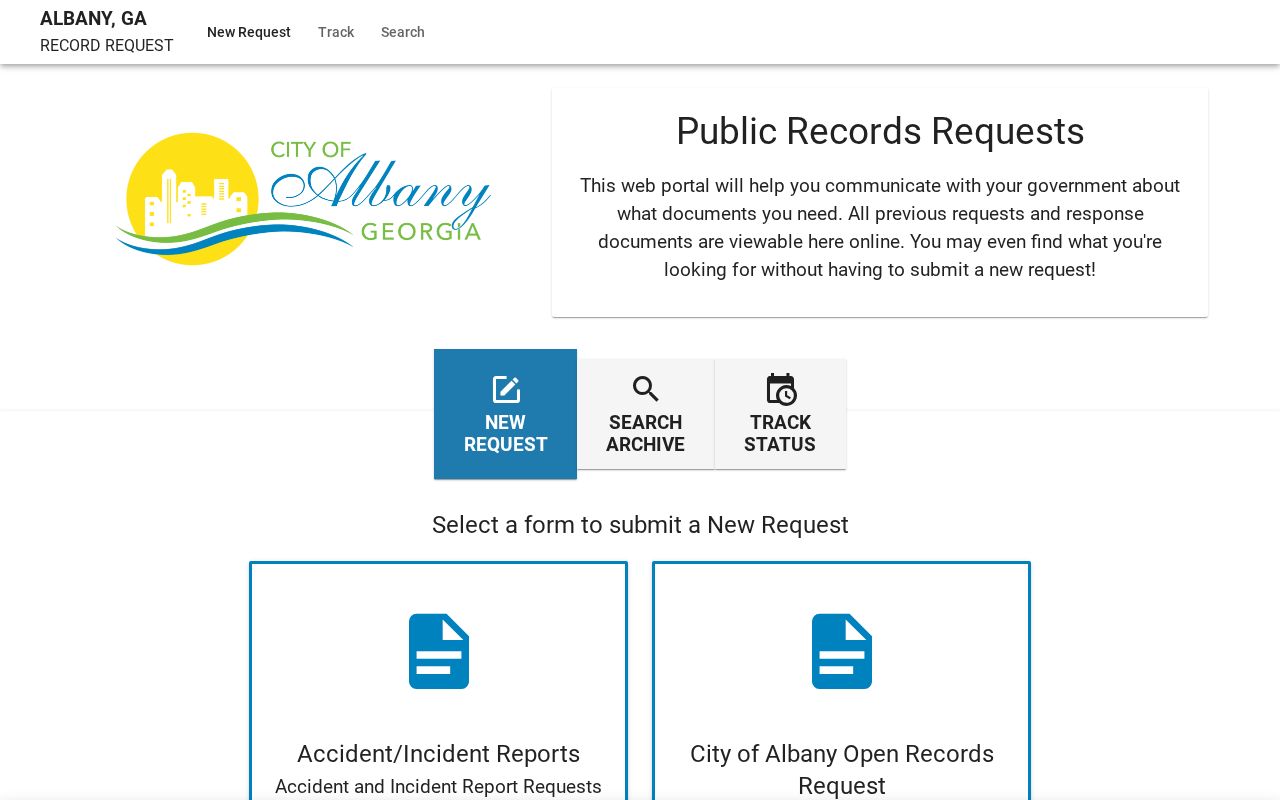
The live form controls the current request types and any conditional fields required for an Albany Police record.
The Albany Police Department
Albany Police creates incident and arrest reports for city policing. The APD Main Desk is at 201 West Oglethorpe Boulevard. Its posted service hours are Monday through Friday, 8:00 a.m. to 4:00 p.m. APD currently lists an $8 local criminal history, with a driver license, state identification card, or military ID required. That local product is not the same as the statewide Georgia Felon Search.
The APD FAQ also lists a $3 copy of a court-case or citation disposition at the Main Desk and accident or incident reports at $0.25 per page. Questions about accident-scene photographs go to the Records Section at 229-431-3278. Fees can change, so verify the posted amount before visiting. A disposition copy at the police desk may help with a known city matter, but the court clerk remains the source for the full docket and certified court file.
The Albany Police FAQ publishes the current counter products and identification rules.
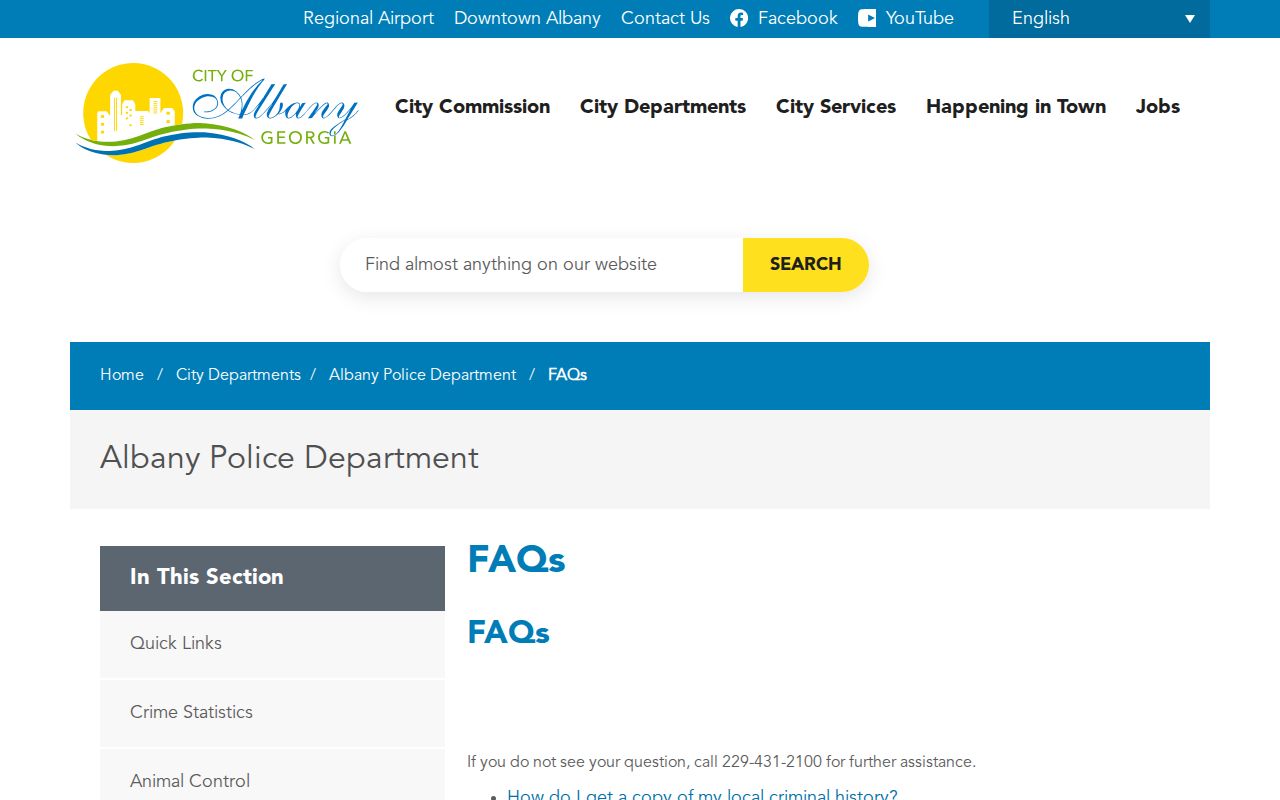
This official fee page helps distinguish an APD local check from a city report request or county court search.
Albany Reports and County Bookings Differ
An arrest by Albany Police can produce two records almost at once. APD creates the arrest report. Dougherty County Jail creates the booking file after intake. The report may contain the officer's account, incident reference, arrest time and place, and charge stated at arrest. The booking file focuses on identity, intake time, presented charges, bond, custody status, and later release or transfer.
The Albany distinction matters because a booking charge can change. A prosecutor may amend, replace, or decline it. Neither an Albany Police report nor a booking proves guilt. To understand what was actually filed and how the Albany matter ended, move to Municipal, State, or Superior Court based on the charge. The separate Dougherty County arrest history resource gives the full county custody and booking chain.
Arrests and Bookings in Albany
People arrested by Albany Police may be booked at the Dougherty County Jail, a pretrial facility at 1302 Evelyn Avenue. The county's official Police-to-Citizen inmate catalog is the first online custody check. Jail intake at 229-430-6531 can help with a very recent booking that has not yet appeared, while the jail main line is 229-430-6500. For a releasable historical booking record, the sheriff publishes DCJF@dougherty.ga.us.
The official inmate catalog is the county source linked for current Albany bookings.
The Albany booking application may change its visible search fields, so follow the live controls rather than assuming a fixed form.
Custody services are not criminal history indexes. JailATM handles commissary deposits, and HomeWAV handles virtual visits. Those services can help a family manage present custody, but they do not show a final court disposition. The jail is large and serves county functions well beyond a single Albany case, so an inmate result must be followed to the correct court.
The JailATM entry is the deposit channel named by the official county materials.

Its role is limited to custody support and should not be confused with an Albany records search.
Albany Municipal Court Records
Albany Municipal Court hears city ordinance matters, state traffic offenses, DUI, underage alcohol possession or consumption, possession of less than one ounce of marijuana, firearms violations, and nuisance or abatement cases. Public court-record requests route through Albany JustFOIA because the court does not publish a stand-alone full criminal docket search. Supply a defendant name, citation or case number, event date, and the record sought.
| Court | Albany Municipal Court, a limited-jurisdiction city court. |
|---|---|
| Case Types | Ordinance, traffic, DUI, underage alcohol, qualifying marijuana, firearms, and nuisance matters. |
| Record Request | Albany JustFOIA or the Municipal Court administrative counter. |
| Useful Keys | Defendant, citation or case number, event date, and requested document. |
| Counter | 240 Pine Avenue, Room 150; 229-431-2865; Monday through Friday, 8:00 a.m. to 5:00 p.m. |
| Fee Status | No complete municipal copy or search fee schedule was found; confirm with the court. |
The Albany administrative and payment counter is in the Albany-Dougherty Tax Building, not the Law Enforcement Center hearing room. Albany posts in-person payment hours of 8:30 a.m. to 4:30 p.m. Personal checks are not accepted. These payment facts do not turn the Albany payment portal into a complete criminal case index.
Albany Ticket Search Is Limited
The official JusticeOne ticket portal searches and accepts payment for covered Albany tickets. It should not be described as a full Municipal Court criminal case search. If a ticket is absent, or if the reader needs pleadings, disposition records, or a non-ticket matter, the proper fallback is the court counter or a JustFOIA request.
The official interface shows the narrower ticket-search function.
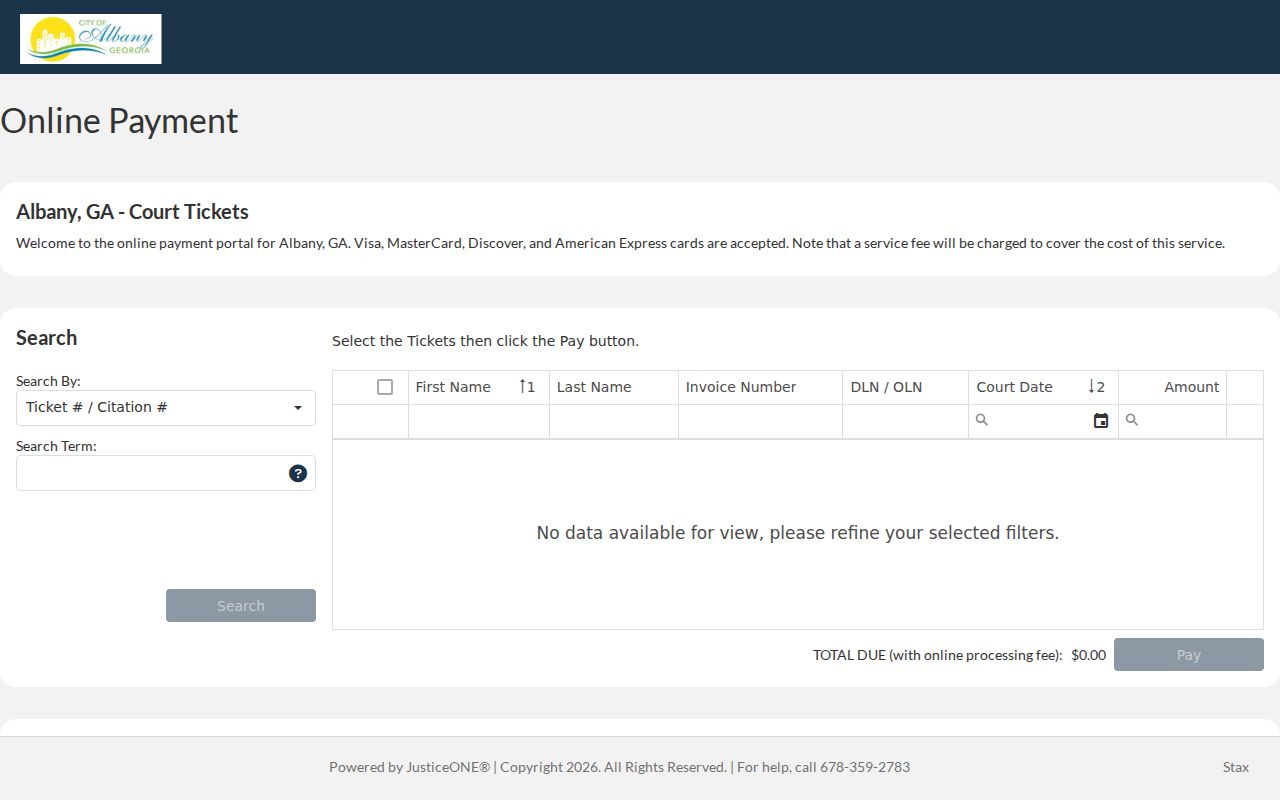
Keeping Albany payment and record-access tools separate prevents a no-result from being mistaken for no Albany court record.
Albany Jail Arraignment Schedule
Albany handles in-custody arraignments at Dougherty County Jail at 7:30 a.m. on Monday, Wednesday, and Friday. Other arraignments and bench trials occur at the Albany Law Enforcement Center, 201 West Oglethorpe Boulevard, on Monday, Wednesday, Thursday, and Friday, starting at 9:00 a.m. or after jail arraignments. Animal and nuisance matters are set on the fourth Friday.
This Albany split explains why one Albany matter can have both a jail event and a city court event at different sites. The booking record shows custody. The Albany Municipal Court file shows the hearing, plea, city-level disposition, and financial entries that the court records. A felony does not stay there merely because Albany Police made the arrest; Superior Court has exclusive felony jurisdiction.
Chief Judge Ingrid P. Driskell's official city profile records her January 29, 2025 appointment.
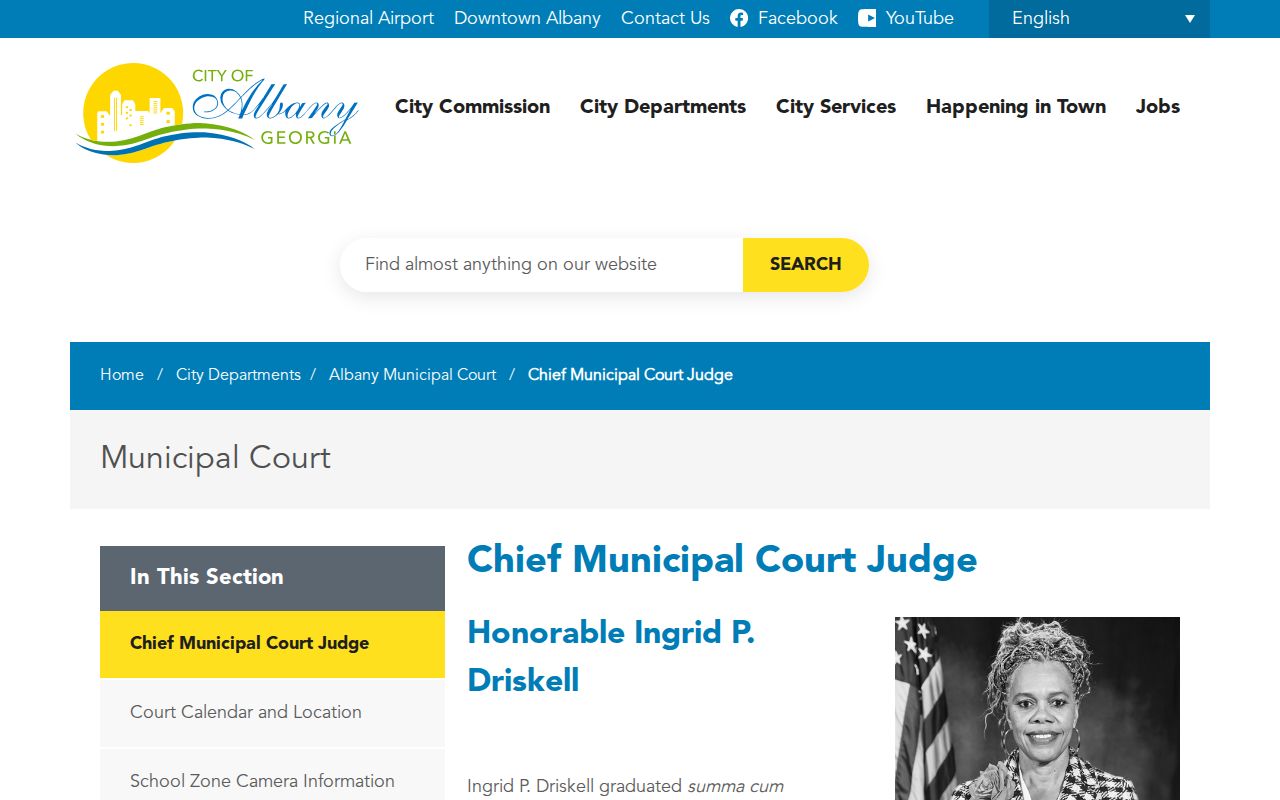
The dated appointment is a useful reminder to check official court pages for current officers and schedules.
Where Albany Records End Up
An Albany incident begins with the agency that responded. When APD makes a reportable custodial arrest, fingerprints and arrest data can move into the GCIC cycle. The county jail creates a separate booking. Prosecutors then determine which charges to file, and the proper clerk records the case. Municipal matters stay with the city court; county misdemeanors go to State Court; felonies go to Superior Court.
Record flow: Albany Police Department › Dougherty County Jail and Courts › Georgia Bureau of Investigation / Georgia Crime Information Center
The final Albany court disposition is reported back to the repository and tied to the arrest cycle. Albany reporting can lag or remain incomplete. When an Albany arrest appears without an outcome, obtain the certified disposition from the court that resolved the matter and use it with the responsible agency's correction process.
Reading Albany Crime Data Carefully
APD changed its crime reporting to the incident-based NIBRS standard on September 3, 2019. Its Crime Analysis Unit and Records Section publish monthly reports, and the department uses the data in weekly COMPSTAT. APD calls the reports snapshots and does not guarantee that an early count will remain unchanged. A dated monthly PDF is therefore more useful than an unsourced claim about Albany crime.
The APD Crime Statistics page links current monthly NIBRS reports.
The Albany page supplies the date and reporting method needed to place an Albany figure in context.
APD also maintains an annual report archive for longer views.
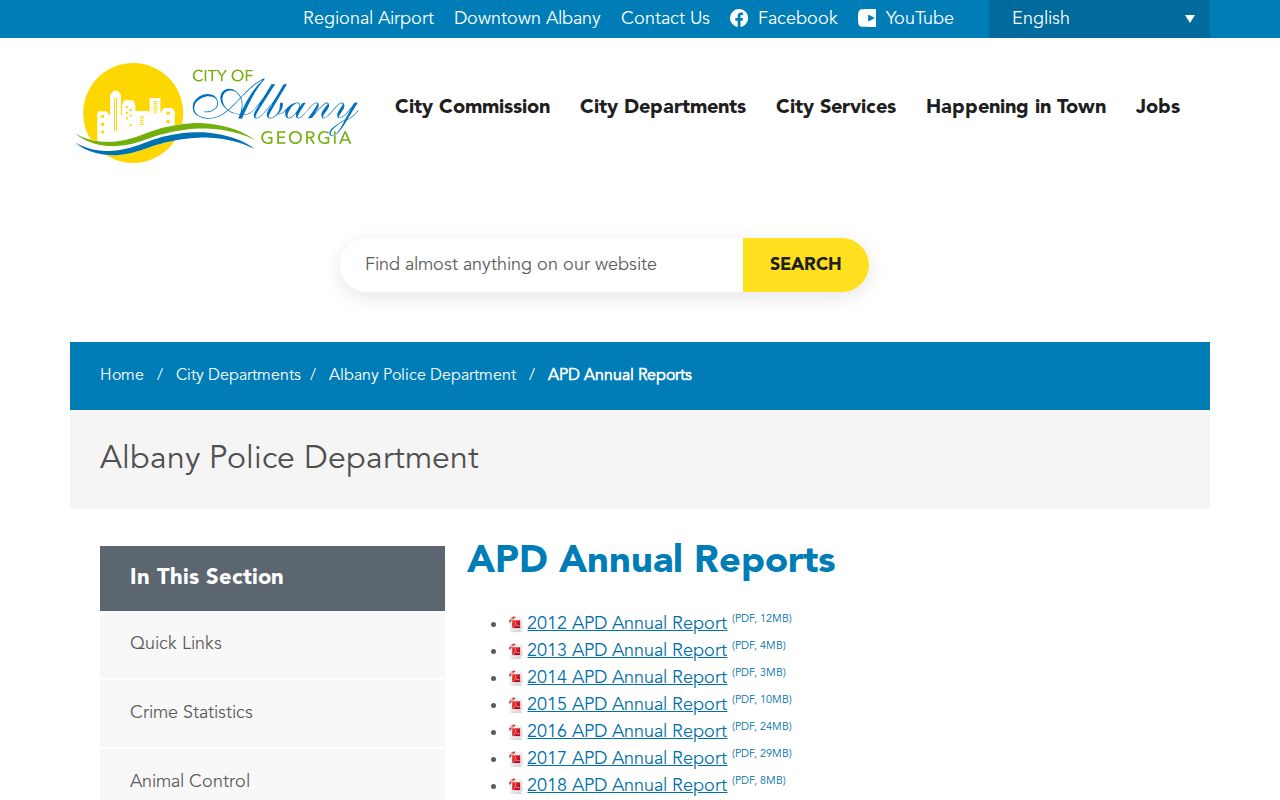
Annual summaries describe the department's work, but they do not replace a named incident, booking, or court file.
Albany REACH Co-Response Program
R.E.A.C.H. means Responding, Engaging and Cultivating Hope. It is an Albany Police and Aspire Behavioral Health co-response program. A caller should use 911 and tell dispatch that an event may need REACH. Patrol first assesses the scene, and the co-response unit joins when appropriate. The program is a city-specific response channel, not a promise that an incident will avoid arrest or court.
The official REACH page describes the local dispatch and assessment path.
If an Albany event creates a public report, APD remains the custodian to ask; any later Albany booking or case must be sought from its own office.
Public Access Rules for Albany Records
The Georgia Open Records Act applies to existing public records held by Albany agencies, subject to exemptions. It does not force APD or Municipal Court to create a report that does not exist or answer open-ended questions. Active investigations, juvenile information, victim details, personal identifiers, medical content, body-camera material, and security-sensitive data may require redaction or withholding. More review can also affect cost and timing.
Key statutes:
O.C.G.A. § 50-18-70 states Georgia's policy favoring public access, subject to lawful exemptions.
O.C.G.A. § 50-18-71 governs response timing, inspection, copies, and allowable charges.
O.C.G.A. § 35-3-37 governs restriction of qualifying arrest and charge information rather than routine destruction.
A focused Albany request names the department, record type, date, place, and identifying number. The city generally responds within three business days, but a response can give a lawful timetable instead of immediate production. Confirm current fees before ordering a large set of records.