
Criminal Cases in Dougherty County Courts
Dougherty County criminal court cases do not all begin at one desk. Superior Court has exclusive felony jurisdiction, including felony pleas, trials, and sentencing. State Court hears misdemeanors and related county cases. Magistrate Court issues arrest and search warrants, conducts committal hearings, and handles bad-check citations and good-behavior bonds. Albany Municipal Court keeps its own city docket for ordinance, traffic, DUI, certain marijuana, firearms, and nuisance matters.
The Clerk of Superior and State Courts is the custodian for those two adult court files. Municipal Court is a separate city custodian, and Juvenile Court files have restricted access. Start with the level of charge and the agency that made the arrest. A felony file belongs in Superior Court even when Albany Police made the arrest, while a city citation may stay in Municipal Court. That first routing choice prevents a false no-record result.
The county's official clerk page shows the shared Superior and State Court records office.
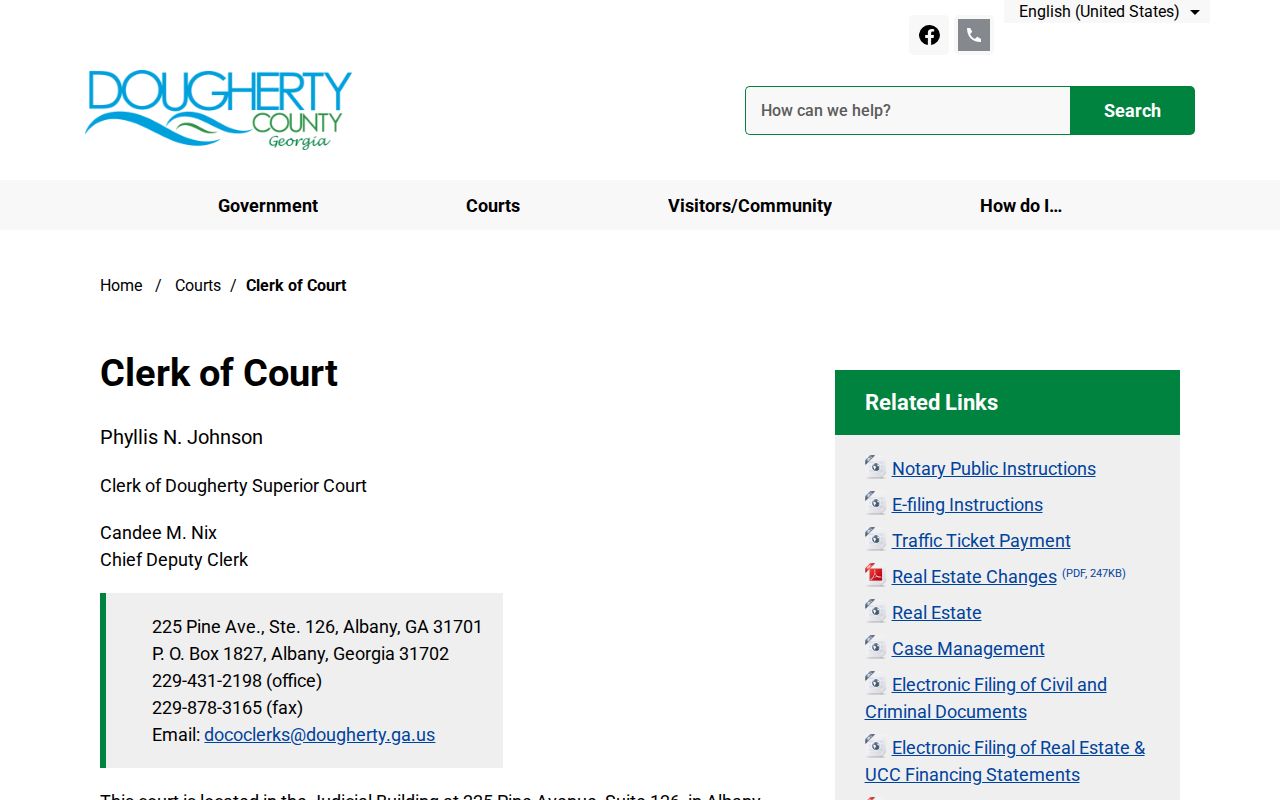
That shared office is why both court levels use one clerk contact even though their criminal jurisdiction differs.
Dougherty Court Roles by Charge
Georgia does not use numbered felony classes. A felony is generally an offense punishable by more than twelve months, life, or death under the governing statute. A misdemeanor is generally punishable by no more than twelve months, though a high-and-aggravated misdemeanor can carry a larger fine. Those labels help identify the likely Dougherty County court, but the filed charge controls.
| Court | Local criminal role | Direct route |
|---|---|---|
| Superior Court | Exclusive felony files, pleas, trials, and sentences | 225 Pine Avenue; 229-302-3752 |
| State Court | Misdemeanors and related county matters | Clerk at the Judicial Building |
| Magistrate Court | Warrants and committal hearings | 225 Pine Avenue; 229-431-3216 |
| Albany Municipal Court | City ordinance, traffic, and listed limited matters | City court and open-records channels |
The county's State Court information confirms the local misdemeanor route.
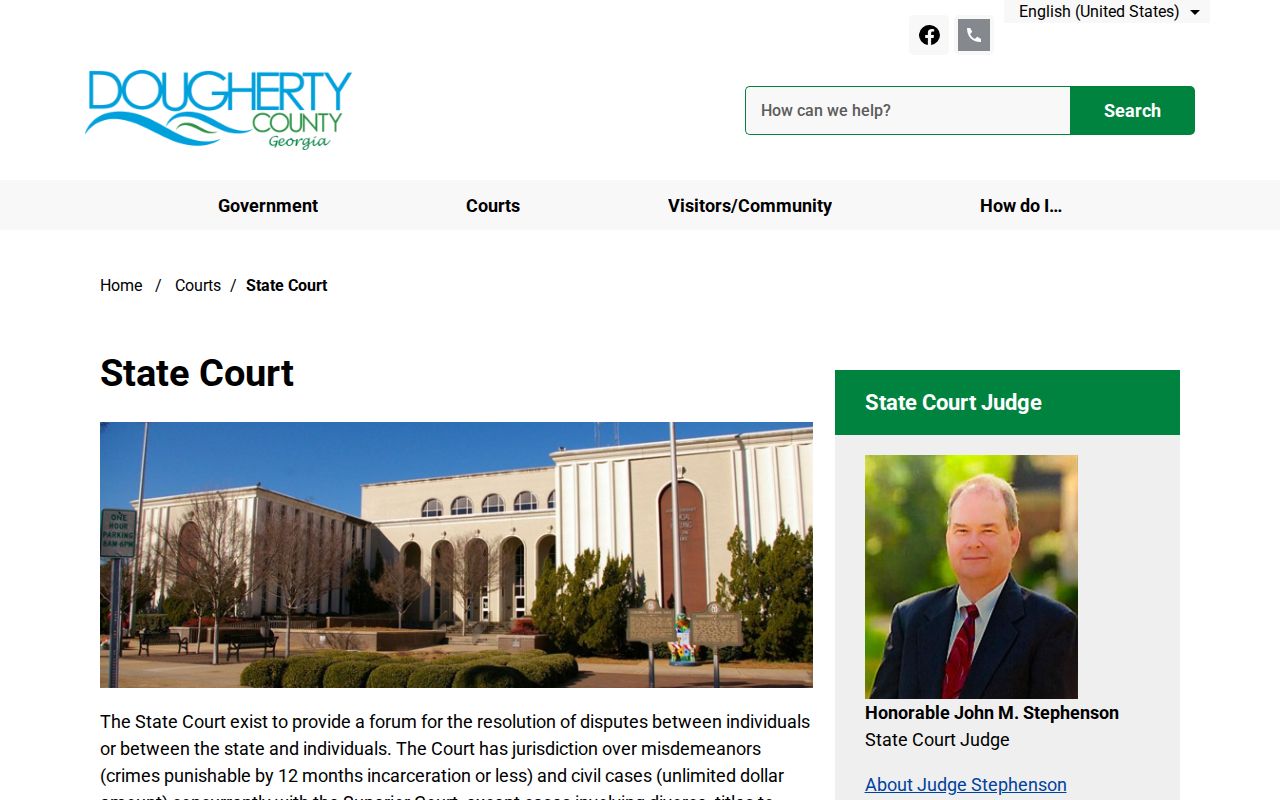
This source helps separate a county misdemeanor file from a felony in Superior Court or a limited city case.
How to Search Dougherty County Case Records
The official Dougherty criminal-case portal offers account controls and a clear Continue as Guest choice. The public landing screen does not prove which filters will appear after entry, so follow the live prompts rather than assuming a name, birth-date, or case-type field exists. The Georgia Judicial Council E-Access directory also routes users to participating provider systems and requires an account. Dougherty State Court is listed there.
- Identify the likely court from the filed charge, not just the arresting agency.
- Open CourtsCMWS and select Continue as Guest, or sign in if an account is needed for the desired record.
- Use only the fields the live portal presents. A known case number is the strongest way to avoid name confusion.
- Read the charge, status, docket entries, disposition, and sentence as separate fields.
- Ask the clerk for the full file or a certified copy when the screen is incomplete or the record will be relied upon.
The county's criminal e-filing instructions document PeachCourt as the filing channel.
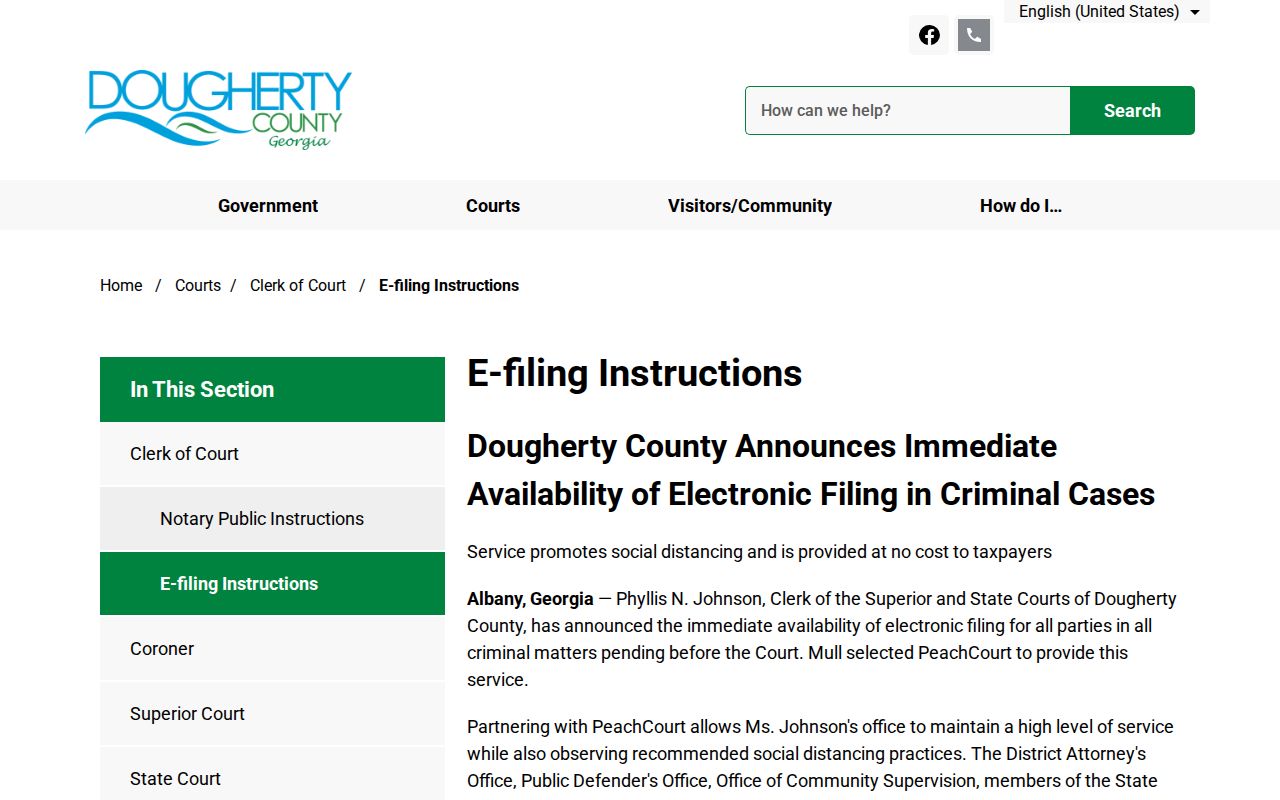
The filing screen supports attorneys and filers, but it should not be mistaken for a complete public case index.
| Field Label | Type | Required | Notes |
|---|---|---|---|
| User Name | Text | For login only | Required for account login, ten-character maximum, converted to uppercase |
| Password | Password | For login only | Required for account login, interface maximum of twenty-five characters |
| Continue as Guest | Button | No | Public entry explicitly offered on the landing screen |
| Create Account | Button | No | Starts account registration |
| Forgot Password | Button | No | Account recovery control |
Dougherty CourtsCMWS Guest Entry
The guest button matters because it distinguishes access from electronic filing. PeachCourt is used for Dougherty criminal e-filing, and the county advertises filing through that service, but PeachCourt is not a complete free public index. CourtsCMWS is the more direct county case-search landing point. Neither portal should be described as containing every old file, sealed matter, or document image.
If guest access does not return the expected Dougherty County case, check the spelling and court level first. Then contact the clerk. Account-gated provider results and a missing web entry do not erase a paper file. Older records, certified copies, and portal help all justify a counter or written request.
What the Dougherty Case File Shows
A Dougherty County case file tracks what prosecutors filed and what the court did. It can include an accusation or indictment, motions, hearing entries, a plea or verdict, the judgment, and sentence. That is broader than a jail booking. The most useful record depends on the question: the charging document shows the formal allegations, the docket gives the event sequence, and the disposition and judgment show the result.
The county's Superior Court page is the source for Dougherty County's felony jurisdiction.
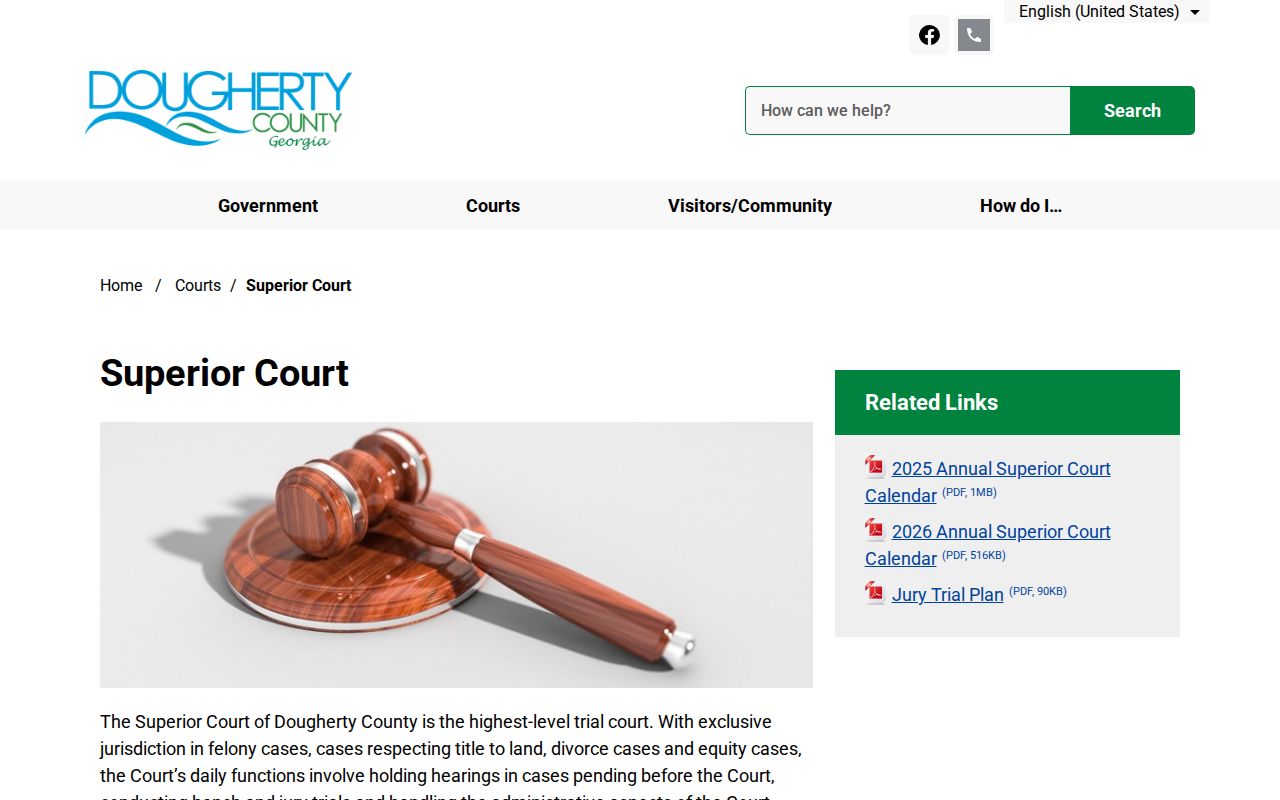
Use that jurisdiction rule to find the formal felony file even when another agency made the arrest.
| Case Number & Court | Identifies the file and whether Superior, State, Magistrate, or Municipal Court holds it. |
|---|---|
| Charging Document | An indictment, accusation, citation, or other filing states the charge brought to court. |
| Docket Entries | Chronological entries record filings, motions, hearings, continuances, and orders. |
| Hearing Dates | Scheduled and completed events help show where the case stands. |
| Disposition & Judgment | Shows dismissal, nolle prosequi, acquittal, plea, verdict, or other recorded outcome. |
| Sentence & Conditions | May list custody, probation, fines, costs, restitution, and court-ordered terms. |
Reading Dougherty Docket Terms
A docket uses short legal terms that can change the meaning of a Dougherty County criminal case. Read each charge separately because counts in one file can end in different ways. A booking label is not a substitute for these court results.
- Accusation
- A prosecutor's charging document, often used for a misdemeanor or an eligible felony.
- Indictment
- A grand jury's formal felony charging document.
- Nolle prosequi
- The prosecutor records that the state will not proceed on the charge.
- Dead docket
- The case is placed in an inactive status without a final trial result.
- Disposition
- The recorded outcome for a charge.
Stages of a Dougherty County Criminal Case
The court file begins with what is formally filed, which may differ from the officer's arrest charge. Arraignment is the stage for formal charge and plea. Pretrial entries can include discovery, motions, bond issues, and scheduling. A plea or trial leads to a disposition, and a guilty result can then produce a separate sentencing entry. Dougherty County does not publish one fixed timetable for all cases, so the live docket is the best event record.
The Magistrate Court page documents the warrant and committal-hearing stage that may precede the trial-court file.
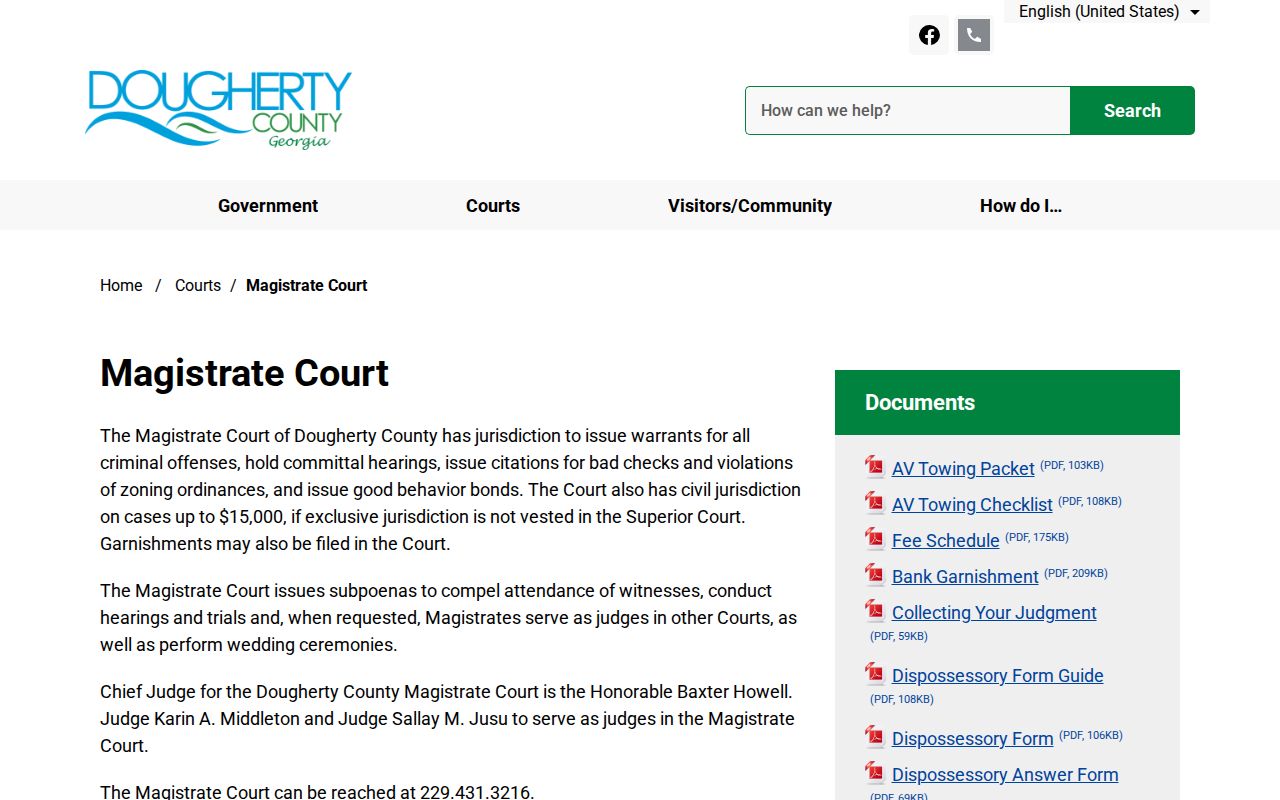
Those early records explain why a warrant or first-stage matter may appear before a prosecutor files the main case.
Case flow: Charges Filed › Arraignment › Pretrial › Plea or Trial › Disposition › Sentencing
Dougherty Booking and Filed Charges
A charge shown at Dougherty County Jail reflects what was presented at intake. The district attorney may later file a different charge, amend a count, decline it, or proceed by accusation or indictment. Compare the booking date and OTN with the court filing, then read each count through its final disposition. This is the safest way to avoid treating an early label as the court's final word.
If the GCIC history still shows an arrest without an outcome, obtain the certified Dougherty County disposition first. GBI directs disputes about arrest data to the arresting agency and disputes about outcomes to the court or prosecutor that supplied the disposition. The clerk can furnish the court document, but the clerk does not rewrite the arresting agency's report.
Dougherty Clerk Certified Copies
The Clerk of Superior and State Courts publishes a specific counter at 225 Pine Avenue, Suite 126, Albany, Georgia 31701. Hours are Monday through Friday, 8:30 a.m. to 5:00 p.m. The main number is 229-431-2198, the email is dococlerks@dougherty.ga.us, and mail goes to P.O. Box 1827, Albany, Georgia 31702.
Use that office for full Superior or State Court files, certified copies, older records, and portal help. Bring the case number if known and state which document is needed. The research did not locate a current certified-copy fee, so verify the price before ordering. This counter is not the custodian for an Albany Police incident report or a Municipal Court file.
Superior and State Court Clerk
225 Pine Avenue, Suite 126
Albany, GA 31701
229-431-2198
Monday through Friday, 8:30 a.m. to 5:00 p.m.
Dougherty Case Access and Restrictions
The Georgia Open Records Act favors access to agency records, but access remains record-holder specific. Court records come from the clerk. Arrest reports come from the agency that created them. The public view may omit Social Security numbers, sensitive birth details, victim information, juvenile material, sealed records, and data protected by another exemption. A web portal can also show less than the full clerk file.
When a Dougherty County case does not appear, ask whether the file is in another court, older than the online coverage, restricted, or listed under a different spelling. Georgia record restriction limits qualifying arrest-charge information from public dissemination but does not ordinarily destroy it. Judicial and criminal-justice access can remain. If the question is the outcome after an arrest, obtain the disposition from the clerk and use the Dougherty County arrest history only as the custody trail.
The sheriff's Judicial Court Services page shows the screening, bond, fine, fingerprint, and warrant functions tied to the courthouse.
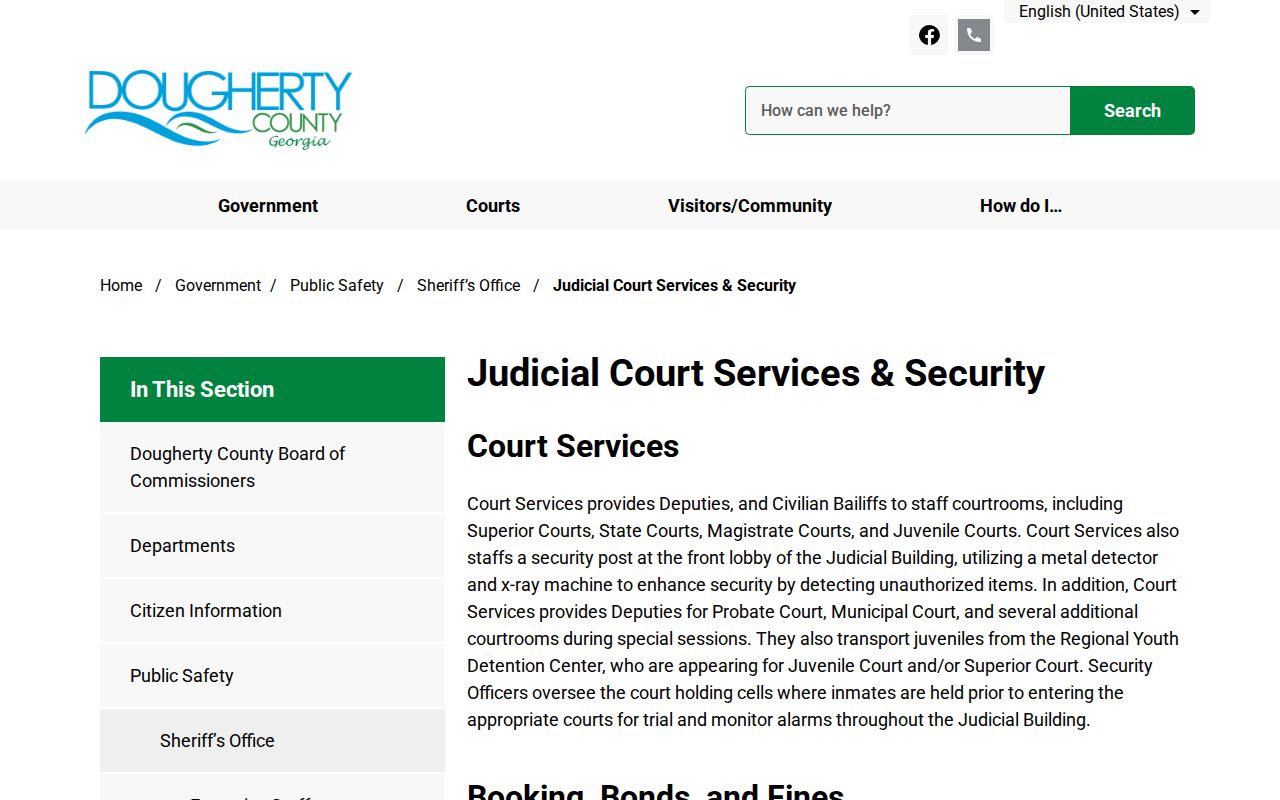
These court-support tasks are distinct from the clerk's duty to preserve and certify the criminal case file.